Jun 3, 2026
2 min read

Clinical behavior is harder to move than you think.
Every prescriber your team will call on this quarter has already made the decision you’re trying to change.
Every pharmaceutical and device company believes strong clinical data should drive adoption. But again and again, even well-differentiated products stall. Not because the science is weak, but because practitioner behavior is already in motion.
Prescribing habits, diagnostic routines, and workflow systems aren’t static decisions waiting to be updated. They are moving systems built over years of reinforcement. And moving systems obey a simple rule: the heavier the object, the more force required to change its direction.
Clinical behavior is no different.
In a landmark study of clinical inertia, researchers analyzed why primary care providers failed to intensify treatment for 135 hypertension patients whose blood pressure remained above goal, despite clear electronic prompts flagging the need for action.
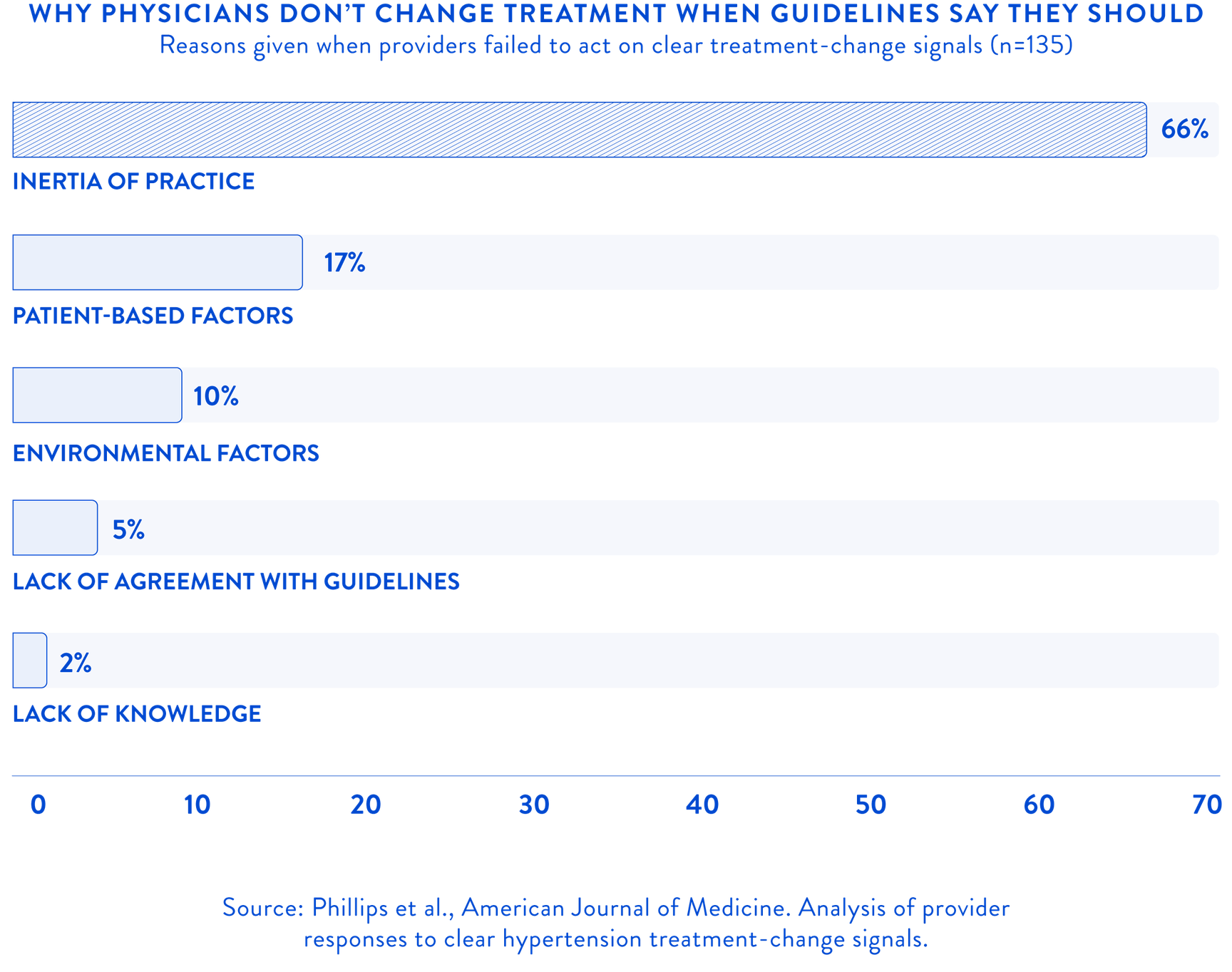
When researchers examined why physicians failed to intensify treatment for patients who clearly needed it, only 2% of cases came down to a knowledge gap, while 66% came down to inertia of practice itself, the system, not the science, was the obstacle. Ophthalmology and optometry practice is no different.
Every prescribing habit carries accumulated weight, reinforced by clinical outcomes, staff training, time efficiency, patient familiarity, risk avoidance, and professional identity. A physician’s current protocol isn’t simply a preference. It’s an operating system. And operating systems are heavy (and hard to change).
Some practitioners carry relatively little behavioral mass. Others are deeply entrenched. Some need only education and awareness. Others require months of repeated reinforcement, peer validation, and clinical confirmation before they’ll move.
When commercial effort is applied indiscriminately (same message, same cadence, same investment per target), it’s almost always spent disproportionately on the highest-inertia segments first. That’s an expensive way to launch.
In physics, inertia describes an object’s resistance to changes in motion. The concept translates directly to clinical behavior change. Three factors consistently determine how much inertia a given practitioner carries in any category:
Clinical Switching Friction – How disruptive is it for the practice to change? Does the new product require new workflows, different dosing protocols, additional monitoring, or staff retraining? The higher the operational disruption, the heavier the behavioral mass.
Cognitive Anchoring – How psychologically committed is the practitioner to their current approach? Years of positive outcomes create deep anchoring. The longer a protocol has “worked,” the harder it is to dislodge, even when something better exists.
Social Proof Dependency – How much peer validation does the practitioner require before acting? Some physicians trust their own assessment. Others won’t move until colleagues, KOLs, or local champions have gone first.
As switching friction rises, as anchoring strengthens, and as social proof dependency increases, the force required to influence behavior rises with them.
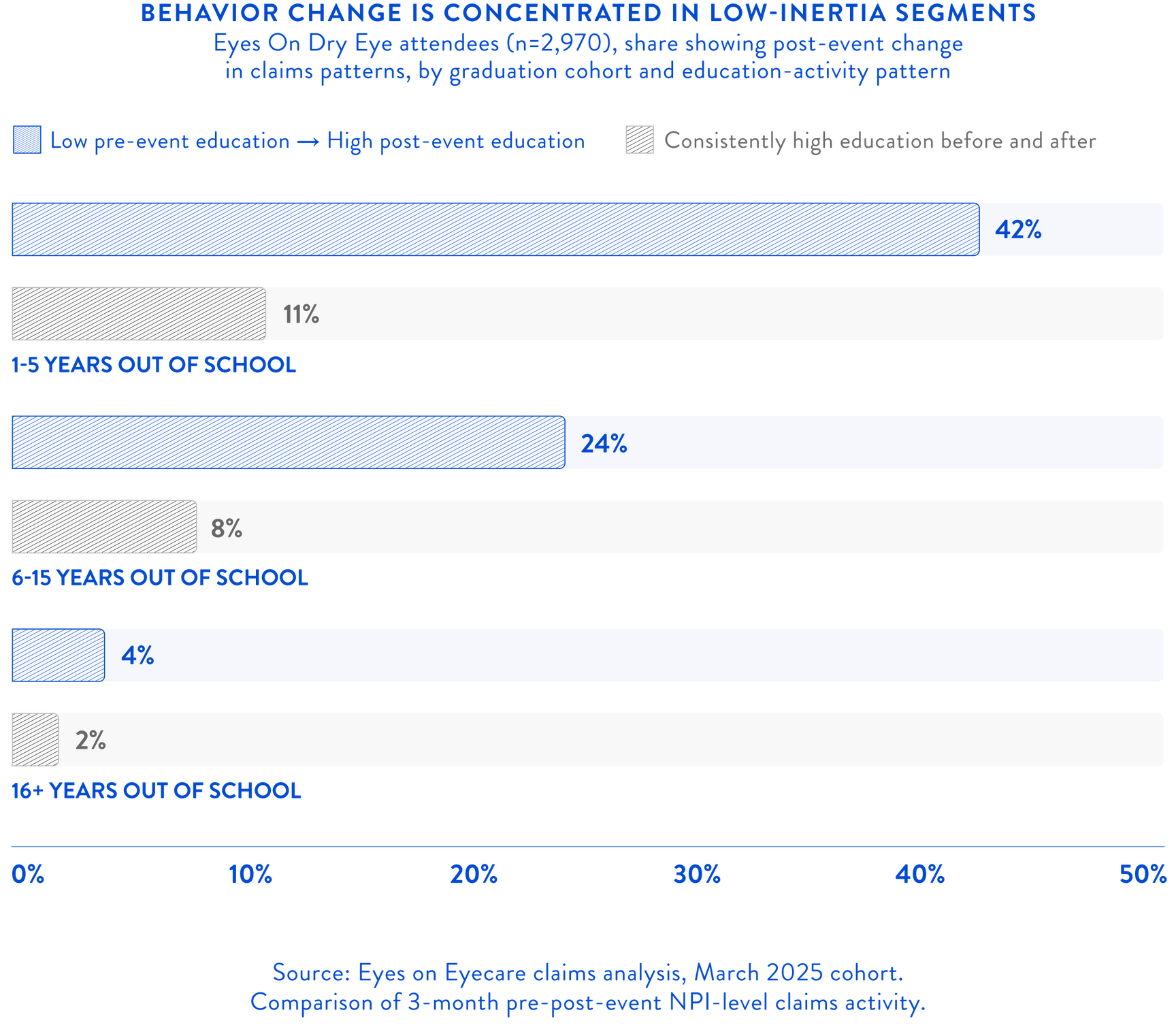
We recently conducted a study where we looked at 2,970 practitioners who attended Eyes On Dry Eye on March 14-15, 2025, to determine what variables impacted change in prescribing, diagnostic, or treatment patterns related to the education hosted at the event. The study looked at changes in clinical claims pattern by NPI number and then spliced it by 2 different dimensions: graduation year, and total education consumed 3 months prior and 3 months post-event.
The findings (below) point in one direction: practitioners with low education activity before the event but high activity afterward were roughly 3× more likely to show measurable change in claims patterns than peers who already consumed high volumes of education prior to the event. The effect compounds with graduation cohort. Among 1-5 year graduates, 42% of the “low-to-high” group showed measurable change in the three months post-event, versus 11% of the consistently-high group, a gap that narrows sharply as years in practice increase.
Counterintuitively, the most educationally engaged practitioners showed the lowest rates of change, likely because deep familiarity with the condition hardens existing practice patterns. Isolating specific ICD, CPT, or NDC codes in future studies would test whether sustained education can move them.
If inertia is the core challenge, then the commercialization goal becomes clear: identify where inertia is lowest, and build momentum there first.
This isn’t an abstract concept. It can be measured, and the organizations that learn to measure it, practitioner by practitioner, category by category, gain a structural advantage in how they allocate effort, sequence outreach, and accelerate adoption.