Sep 16, 2026
2 min read


What’s the value of an article beyond the page view? Recent Eyes On Eyecare data shows article readers are 47% more likely to complete education, offering a new perspective on how content can support deeper ECP engagement.
Eyecare executives sometimes separate content, email, events, and education into different plans, budgets, and performance reports. ECPs experience them as one connected educational experience. An article can introduce a clinical issue or make it newly relevant. Email can keep that topic present. An event can create a concentrated moment of interactive participation. A course can help an ECP translate knowledge into clinical action.
Eyes On Eyecare’s own proprietary engagement data shows why those elements are more valuable together. Across ECPs with measurable annual engagement, approximately 51% read an article, 51% registered for an event, and 38% completed a grant-supported course. Nearly 90% engaged with email, giving marketers a broad channel for maintaining visibility across the journey.
The most commercially important finding is what happens among article readers. ECPs who read articles are more likely to register for events and complete formal continuing education than engaged ECPs who do not read articles. The data cannot establish that an article caused the deeper behavior or always occurred first; it does, however, show that content engagement identifies an audience with a stronger relationship to deeper professional experiences.
For supporters and medical affairs executives, articles create relevance and identify interest. Advanced educational curriculum gives that interest somewhere meaningful to go.
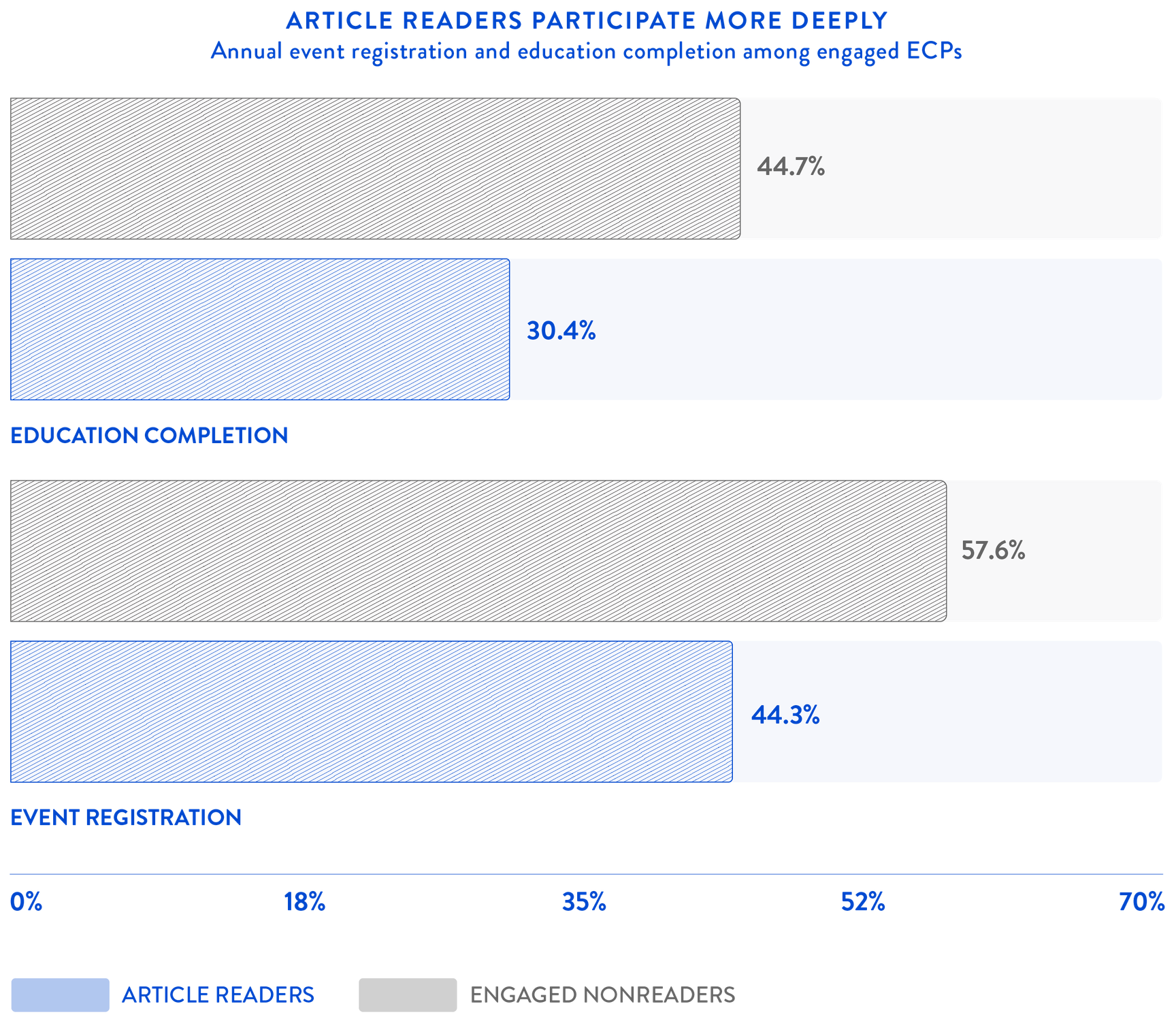
Analyzing Eyes On Eyecare’s own data across all categories during the 365-day period, 44.7% of article readers completed education. Among engaged ECPs who did not read an article, 30.4% completed education. Article readers therefore showed a 47% higher education completion rate.
The same pattern appears in event participation. Among article readers, 57.6% registered for an event, compared with 44.3% of engaged nonreaders. That represents a 30% higher event registration rate.
This is not a claim that content alone produces every course completion or event registration. It is evidence that article engagement is a valuable signal. A reader has already chosen to spend time with a clinical topic. That creates an informed audience for an invitation to continue learning.
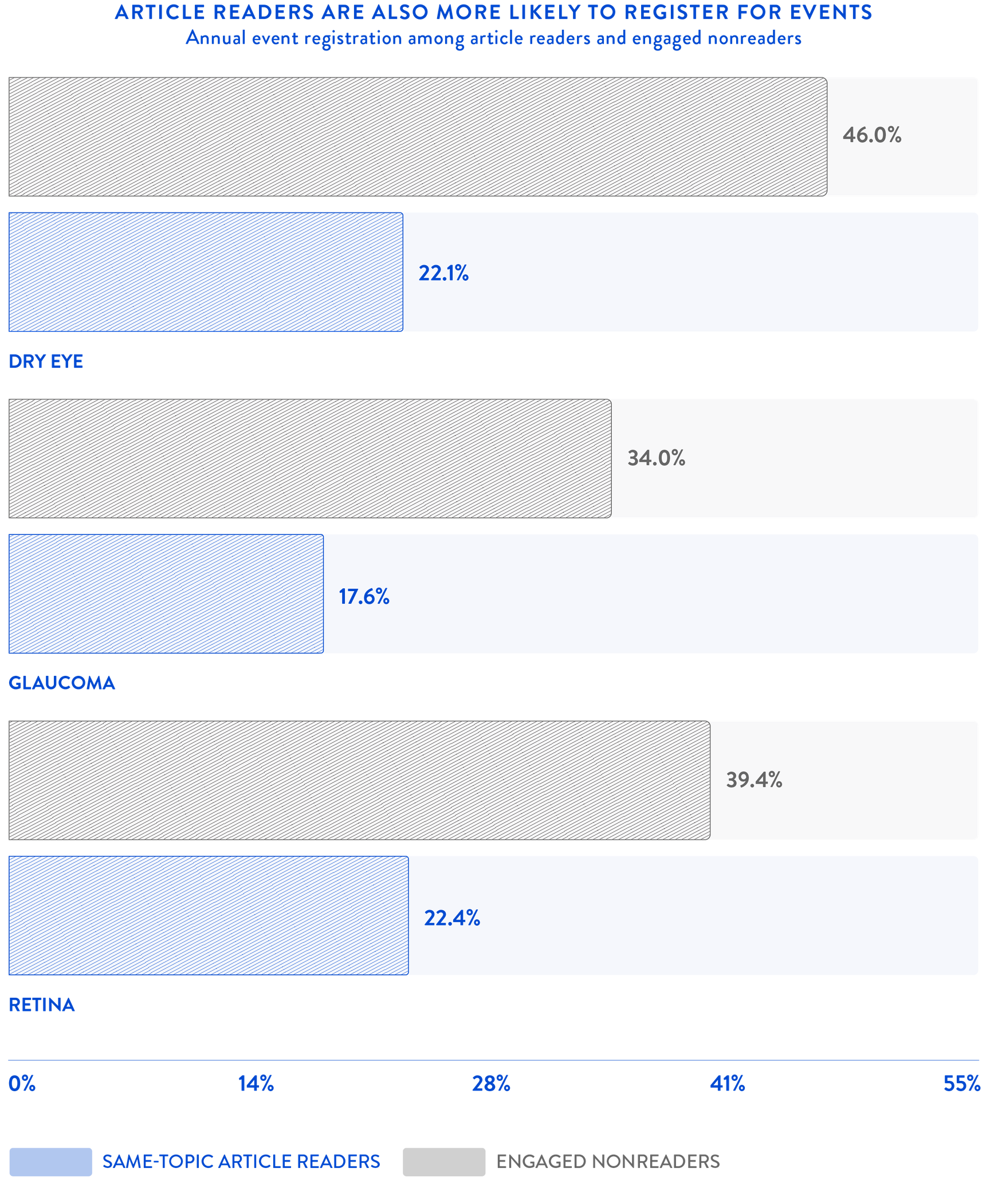
Article readership is associated with higher event registration in the same priority categories. In dry eye, 46.0% of article readers registered for an event, compared with 22.1% of engaged nonreaders. The reader rate was 34.0% versus 17.6% in glaucoma and 39.4% versus 22.4% in retina.
It also gives marketers and medical affairs executives a more useful way to evaluate content. The value of an article is larger than the page view itself. Its contribution includes the audience it develops, the first-party interest signal it creates, and the next educational experience it can inform.
For marketers, this expands the role of editorial content. Articles can support an event before registration opens, build familiarity with the clinical problem, and extend the value of the discussion afterward. Content gives a live or virtual program a longer life than the event date alone.
For education leaders, events can also be part of the curriculum rather than a separate activation. A live discussion can introduce a key insight, reinforce a course module, or help clinicians apply knowledge through cases and peer conversation.
The data supports an integrated model with four distinct jobs:
This model gives marketers and medical educators a connected audience strategy. An ECP who reads an article about dry eye diagnosis is more likely to be interested in a relevant course. A clinician who completes that course can be invited to an advanced case discussion. Someone who attends the event can receive follow-up content that reinforces the message and introduces the next learning module.
The findings suggest that content and formal education should be planned as complementary parts of a professional learning strategy. Content can establish interest around a clinical topic before a curriculum begins, maintain relevance while courses are available, and reinforce key themes after formal education concludes.
A multi-course curriculum provides the time and range needed to address complex educational needs across different levels of knowledge and readiness. It also allows learning to progress from foundational concepts to clinical application and reinforcement over an extended period.
Within this model, content creates visibility into topic-level interest, while curriculum provides structure and depth. Connecting these elements creates a measurable educational ecosystem that can evolve based on clinician engagement, participation, and emerging learning needs.
The strategic opportunity is to imagine an ECP learning journey, with each component serving a distinct role in developing and sustaining professional engagement.
The analysis uses topic-level engagement indicators from the Eyecare Executive project. The population includes ECPs with at least one measurable engagement signal during the 365-day window. The findings are descriptive associations. They do not establish causation or exact interaction order. Event data represents registration, and education data represents completion. The primary topic comparisons in this article use dry eye, glaucoma, and retina because the source classifies them as reportable.