Sep 29, 2026
2 min read


Six years of Academy data show two shifts at once: what optometry is teaching, and who is teaching it. Industry investment hasn't caught up with either.
The American Academy of Optometry meeting opens in Anaheim tomorrow, September 30. For most industry teams, the Academy playbook hasn't changed in years: a booth, a symposium or two, and dinners with a familiar list of about 20 KOLs.
The meeting itself, however, has changed a great deal and the data I will share below proves it.
Few meetings show where optometry is heading as clearly as Academy does. It has long been the profession's home for rigorous, evidence-based education. Its faculty has grown from about 250 educators in 2021 to close to 400 in 2026, across nearly 20 specialties. They range from national leaders to fast-rising clinicians and everyday practitioners. For any company serving eyecare, Academy is where you can watch optometry's clinical priorities take shape, and meet the educators shaping them.
Our data team analyzed the sessions and faculty at the last six Academy meetings, from Boston 2021 through Anaheim 2026, and matched each year's faculty to CMS Open Payments.
Three findings matter for pharma and device leaders:
New topics. Medical and disease-management specialties now hold 58% of the program's specialty focus, up from 48% in 2021. Oculoplastics, systemic disease, and retina gained the most.
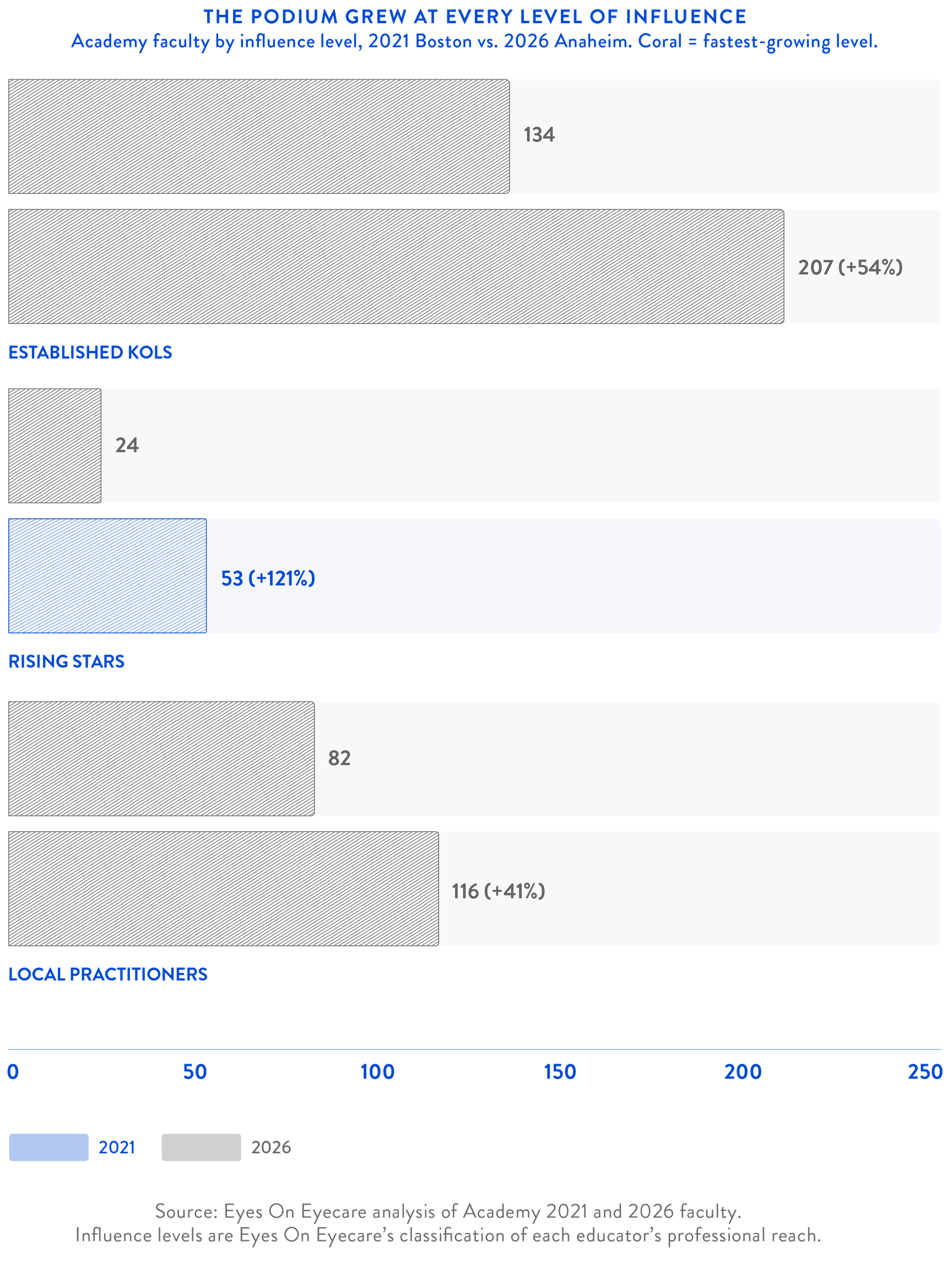
New voices. The faculty grew by nearly 60%, and rising-star educators more than doubled. Industry payments are spreading well beyond the top names.
Money in old places. Ocular surface companies fund about a third of the 2026 faculty's industry relationships, nearly three times that area's share of the program. Retina and oculoplastics are barely funded.
Academy's program has tipped toward disease detection and management. Conference programs are a leading indicator: what faculty choose to teach shows where clinical practice is heading before it shows up in claims data.
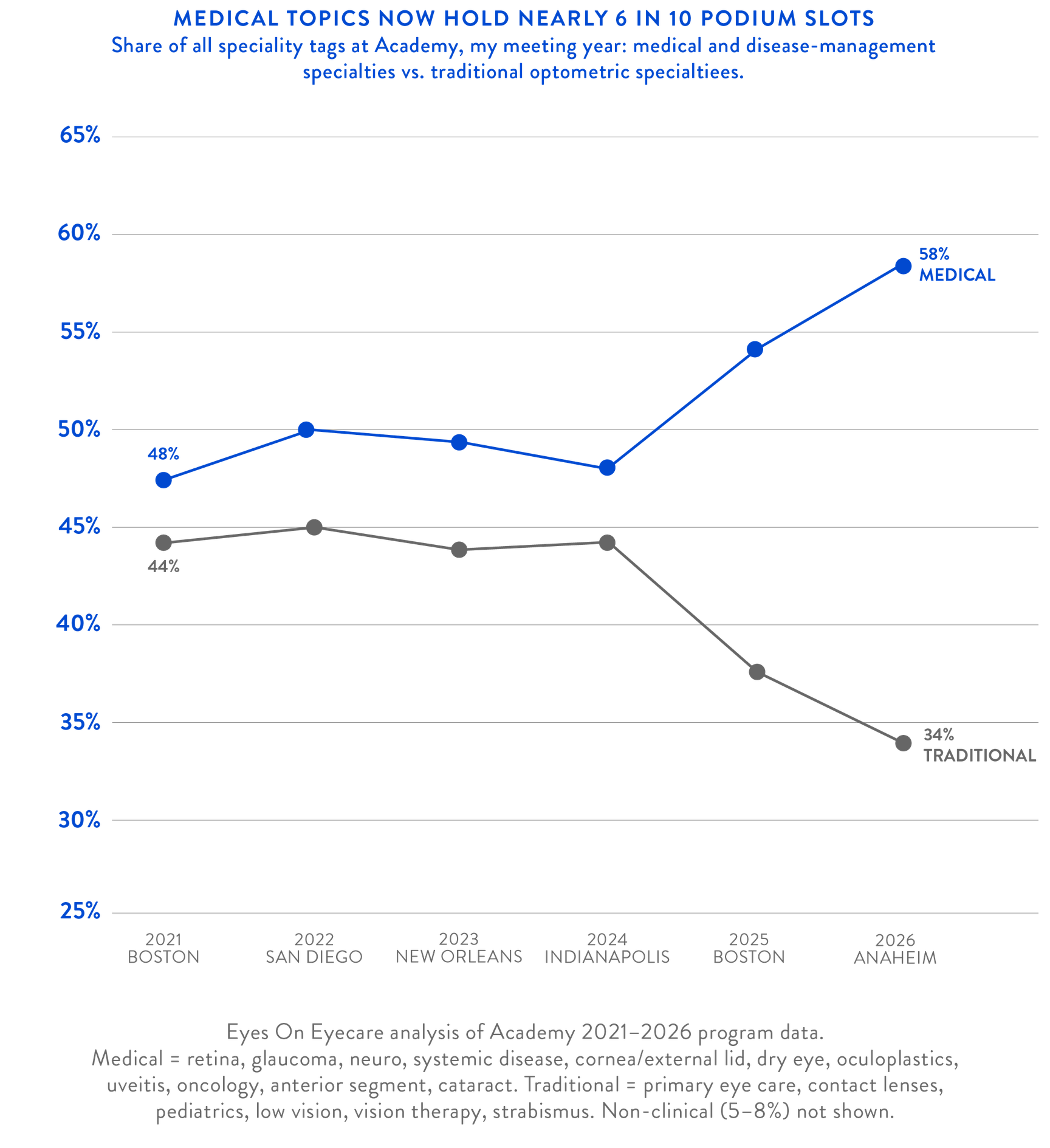
Most of the shift came at the last two meetings. Through 2024, medical and traditional topics held a steady balance. In Boston 2025 and Anaheim 2026, medical content pulled clearly ahead.
Academy's faculty grew from roughly 250 educators in 2021 to 397 in 2026, and the growth reached every level of influence. Earning a place at the podium no longer requires a decades-long national profile.
Industry support is following the wider podium as well. The 10 highest-paid speakers received 68% of industry payments to the faculty in 2021, and 45% in 2026. Payments to speakers outside the top 25 rose nearly sevenfold, from about $200,000 to $1.37 million, while total payments roughly tripled.
The top names have become more expensive at the same time. The 25th-highest-paid speaker received about $16,000 in 2021 and about $82,000 in 2026.
Now keep in mind, these are not payments for speaking at Academy directly. They are each speaker's total industry payments for the year, across all of their consulting, speaking, meals, and other work, which we totaled for the educators who happen to be on Academy's faculty. Year-to-year swings can also reflect timing, such as new drug or product launches; data to be interpreted as general trends rather than a precise measure.
Industry's investment in Academy faculty is still concentrated in one clinical area. Among the 2026 Anaheim faculty, payments total $5.5 million across 74 companies, up from $1.8 million in 2021 (a COVID-depressed baseline, so the growth is overstated).
This is a good sign: this shows that medical education stays independent but is still considerate of industry trends like new drug releases.
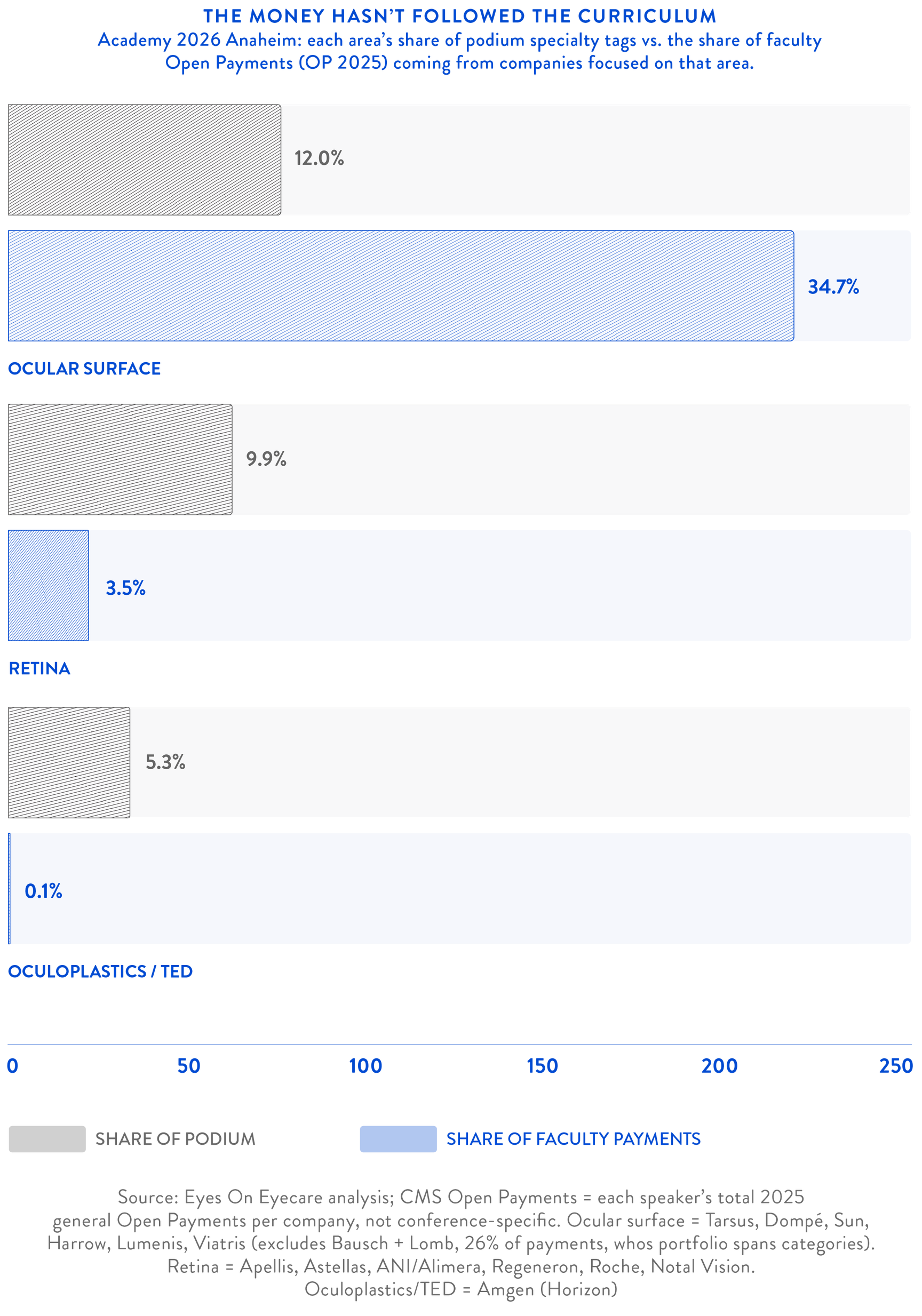
Some of this makes sense. Optometrists prescribe ocular surface therapies directly, while retina drugs are injected by retina specialists. But the picture is already moving in an encouraging direction.
Companies that launched new therapies during this window, first in ocular surface (like Tarsus) and increasingly in retina (like Astellas or Apellis), have built relationships with Academy faculty quickly in the years around their launches. It's a positive signal that industry sees optometrists as essential partners in detection, treatment, and referral, and that Academy's faculty is where those partnerships begin.
With the meeting days away, budgets and booths are set; flights and lodging are booked. But there are still powerful opportunities to seize before landing in California — and these moves cost nothing but time:
If Academy 2027 confirms the shifts of the last two meetings, 2027–2028 budgets should follow where the podium has gone:
Methodology: Eyes On Eyecare analysis of Academy 2021–2026 session and faculty data. Specialty shares compare the proportion of each program, not raw session counts. Influence levels are npiQ's classification of each educator's professional reach. Payment figures are each speaker's total general payments from CMS Open Payments for the program year before each meeting, not conference-specific payments. Company and therapeutic-area groupings are approximate. Individual speakers are not named.