Oct 21, 2026
2 min read


A company’s ophthalmology KOL strategy should account for the different ways physicians contribute to scientific exchange and clinical education across career stages. Emerging researchers bring perspectives from current training and developing areas of investigation. Experienced faculty help translate evidence for broader clinical audiences, while investigators and established authorities contribute clinical experience, specialty context, and mentorship.
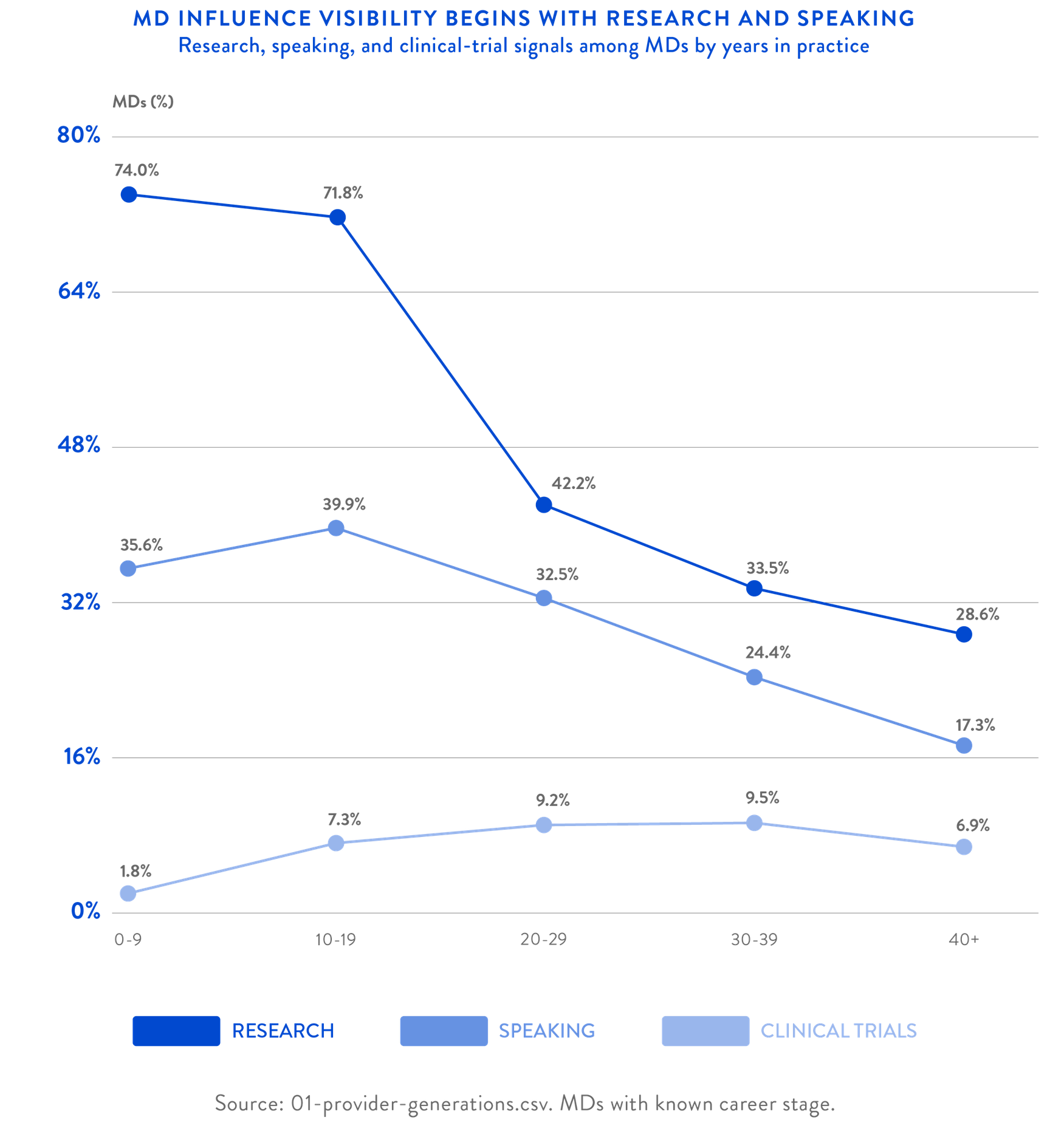
Among early-career ophthalmologists, research is the most prevalent way MDs influence. Nearly three-quarters of MDs in the first two career-stage cohorts have research activity. Speaking also appears early, while clinical trials become more common later.
The data points to an opportunity to develop physician relationships over time and assemble complementary voices within individual programs. A research-focused contributor may help explain an emerging finding, while a practicing investigator can explore its implications for patient selection and an established authority can place it within the specialty’s evolution.
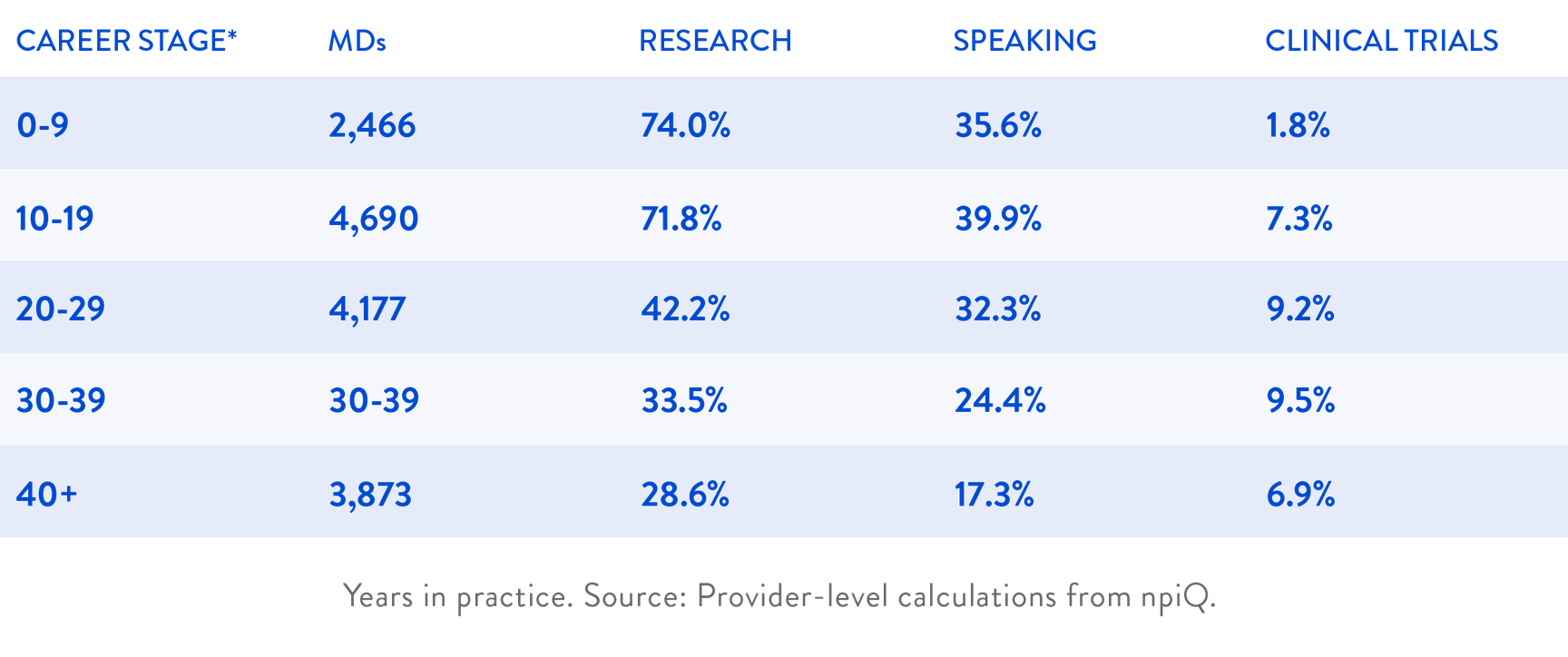
MDs in their first nine years of practice are highly visible through research. In fact, 74% have research activity, and 35.6% have at least one speaking activity. At this career stage, clinical-trial participation remains comparatively low at 1.8%, reflecting a point in time in which many physicians are establishing research interests, institutional relationships, and areas of specialization.
These physicians can help:
The strategic opportunity is to identify these physicians before their visibility is fully established. Engagement at this stage should emphasize scientific credibility, substantive participation, and long-term relationship building.
The 10–19-year cohort represents an important bridge between early career research and broader clinical authority. Research activity remains high at 71.8%, speaking reaches its career-stage peak at 39.9%, and clinical-trial activity increases to 7.3%.
These physicians are well positioned to connect scientific evidence with the decisions clinicians face in practice. They have enough experience to speak with authority while remaining close to emerging research, new technology, and changing treatment approaches.
They can play valuable roles in:
This is a critical KOL-development period. Companies should assess which physicians are gaining speaking reach, broadening their clinical influence, and demonstrating the ability to make complex evidence useful to other clinicians.
The strongest combination of clinical-trial participation, patient scale, and treatment volume appears across years 20–39. Trial activity reaches 9.2% in years 20–29 and 9.5% in years 30–39. Speaking remains meaningful at 32.3% and 24.4%, respectively.
Physicians at this career stage can help companies understand how an innovation performs beyond the initial data. Their experience is particularly valuable when adoption depends on patient selection, workflow changes, referral coordination, treatment sequencing, or complex cases as they have real-world experience to rely on to assist with interpreting data and managing change.
They are strong candidates for:
This cohort can connect scientific credibility with operational credibility.
MDs with 40 or more years in practice show lower rates of tracked research, speaking, and clinical-trial activity than other cohorts. These established authorities contribute a distinct form of influence built through accumulated experience, specialty history, professional relationships, and institutional knowledge.
Established authorities may be best suited to:
The central implication is that KOL strategy should function as a long-term talent and relationship portfolio. The goal is to understand where each physician is in developing their influence, what they are best equipped to contribute today, and how that role may evolve over time.
This edition includes npiQ providers classified as MD in the profession field. The provider-generations file contains 25,572 MD records, of which 19,180 have a known career-stage band used in the main comparisons.