Aug 5, 2026
2 min read


Part 2: How to measure practitioner inertia and invest your effort where it will actually move the market. Most campaigns rank physicians by prescribing volume, concentrating effort on the practitioners who write the most today. But volume does not reveal who is most likely to change—or whose adoption will influence others. A smarter campaign prioritizes low-inertia, well-connected practitioners first, turning early conversions into peer validation, lowering the cost of each adoption that follows, and creating momentum that moves more of the market.
Most teams already know who their high-volume prescribers are. Volume tells you who matters, but not who will move—and early in a launch, that second question determines success.
In my last article, I discussed the three forces that can make practitioner behavior especially resistant to change: clinical switching friction, cognitive anchoring, and social proof dependency. Each leaves a trace in data you either already have or can access through npiQ. Turn those signals into inputs, and you can rank practitioners by how much effort may be required to change behavior:
Layer these signals into your targeting, and you’re prioritizing on likelihood to change, not just market value. Think of it as an inertia score: a way to rank practitioners by how much effort it will take to move them, not just by what they’re worth.
Force comes in many forms: field engagement, sampling, clinical education, conference presence, peer-to-peer programs, local champions, word of mouth. Different practitioners need different combinations.
A newer physician with low friction and high education engagement might convert on one well-timed conversation. A deeply anchored high-volume prescriber might need months of peer validation. Run the same playbook on both, and you overspend on the ones who aren’t ready while underspending on the ones you could have won cheaply.
The cost of that mismatch adds up quickly. Yet most teams still build their target lists the same way: rank physicians by prescribing volume and hit the top deciles hardest. But volume tells you where the prescriptions are today, but it doesn’t tell you where a change is still possible. When every competitor is crowding the same high-volume names, the return on each additional call shrinks, and much of your most expensive effort lands on the practitioners least likely to move. Spending as if volume equals opportunity is how launches burn budget without moving the market.
Newer practitioners are easy to skip because their volume can be low. But volume is a trailing indicator, and there's a reason to look harder at physicians earlier in their careers: their habits are still forming, and their protocols are still evolving, which means the right input can still change the trajectory. Moreover, a subset of the newer practitioners can become the physicians who validate the product for their more anchored colleagues later.
That last point is where the real leverage is, and the evidence for it is strong. In a study of nearly 12,000 physicians using commercial and Medicare claims data, researchers measured how much each physician’s adoption of a new drug influenced the doctors who shared patients with them. The finding cuts to the heart of the volume question: physicians in the top decile for peer connections had nearly twice the downstream influence on their colleagues’ adoption as physicians in the top decile for prescribing volume. The best-connected doctor moves more of the market than the busiest one.
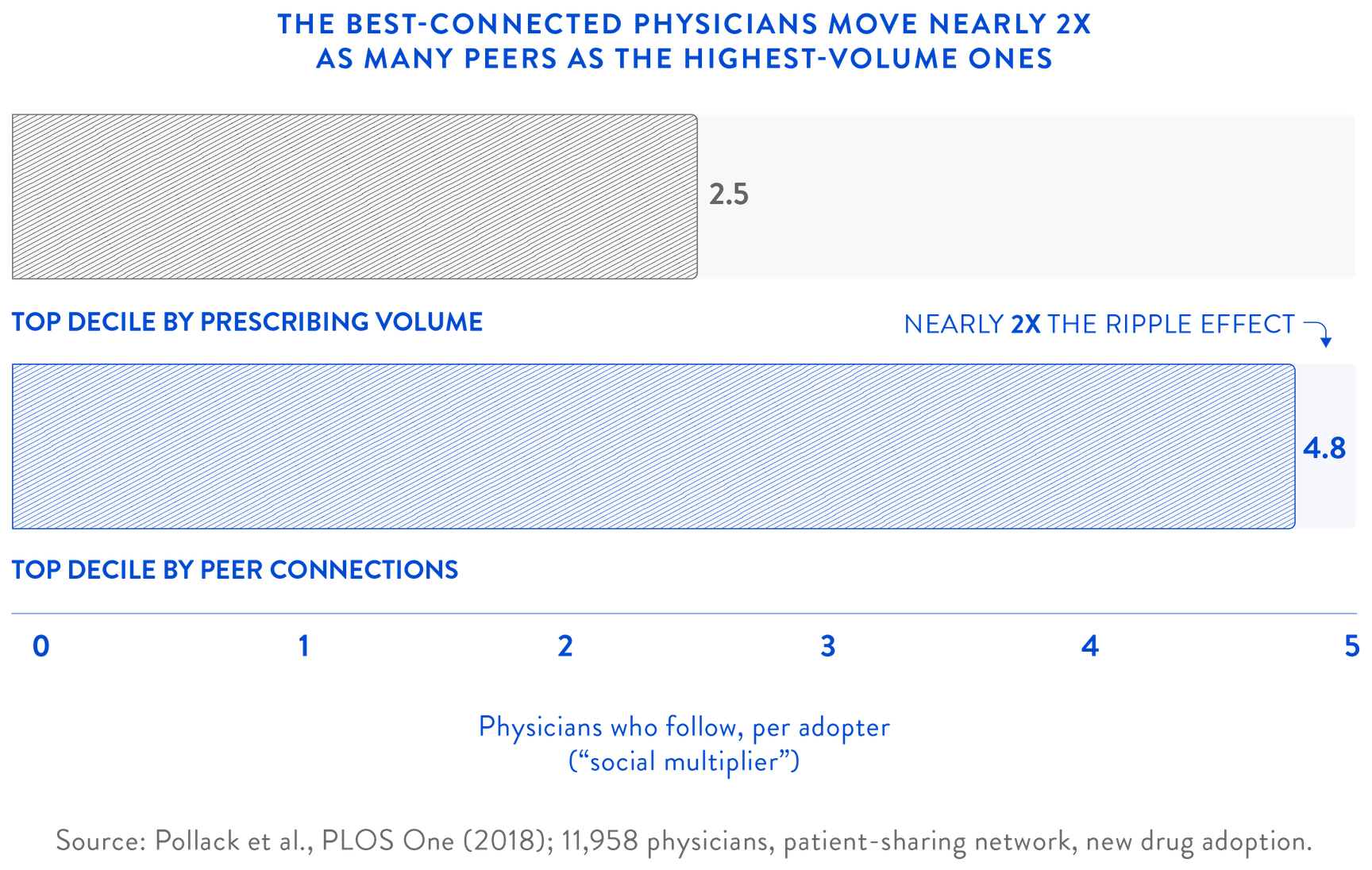
The practical implication is that a target’s value isn’t just their own prescriptions; it’s the prescriptions they set in motion. Convert a well-connected, low-inertia physician early, and you lower the cost of every conversion that follows in their network.
At launch, you supply nearly all the force. Every conversion is hard-won. But once the right early segments start moving, something changes. Practitioners mention the product to colleagues. Referral networks normalize it. Perceived risk drops, and inertia drops with it. That’s the point where the market starts supplying force on your behalf, and your job shifts from pushing to steering.
That momentum is built by choosing the right first movers: low-friction practitioners who are also positioned to influence others.
Practitioner inertia isn’t a flaw in the market: it’s a predictable feature of high-stakes clinical decision-making, and it’s measurable. Build your launch around it, and you’ll spend less, move faster, and outperform teams that treat every target the same. The question was never whether force is required: it’s where to apply it first. Prioritize inertia score over prescribing volume, and you’re more likely to build a faster, more efficient launch.