Nov 4, 2026
2 min read


Commercial teams often know which clinicians currently prescribe their products. The harder question involves understanding what separates clinicians who regularly incorporate branded therapies from those who rarely do. An analysis of 63,950 clinicians in npiQ provides several useful signals for eyecare executives building targeting, segmentation, and engagement strategies. The findings point toward a more sophisticated definition of commercial opportunity. Specialty matters, but specialty alone leaves important information unexplained. Clinical activity, prescribing volume, practice structure, and professional engagement add meaningful context around where branded treatment decisions are most likely to occur.
For this analysis, a branded prescriber means a clinician whose branded products represent at least 10 percent of total prescription volume. That definition identifies 37,411 clinicians within npiQ, representing 58.5 percent of the 63,950 clinicians analyzed. The remaining 26,539 clinicians form the comparison group.
The threshold identifies clinicians for whom branded therapies already hold a meaningful place within the prescribing mix. It does not indicate loyalty toward any particular manufacturer or product. Patient needs, treatment availability, affordability, payer access, and therapeutic alternatives can influence every prescribing decision.
For an eyecare executive, these clinicians are a useful starting point for understanding branded prescribing behavior, not a finished commercial target list.
The largest differences appear across clinical focus, overall activity, prescribing volume, and practice structure. Dry eye provides the most pronounced positive difference, with branded prescribers 20.9 percentage points more likely to practice within dry eye.
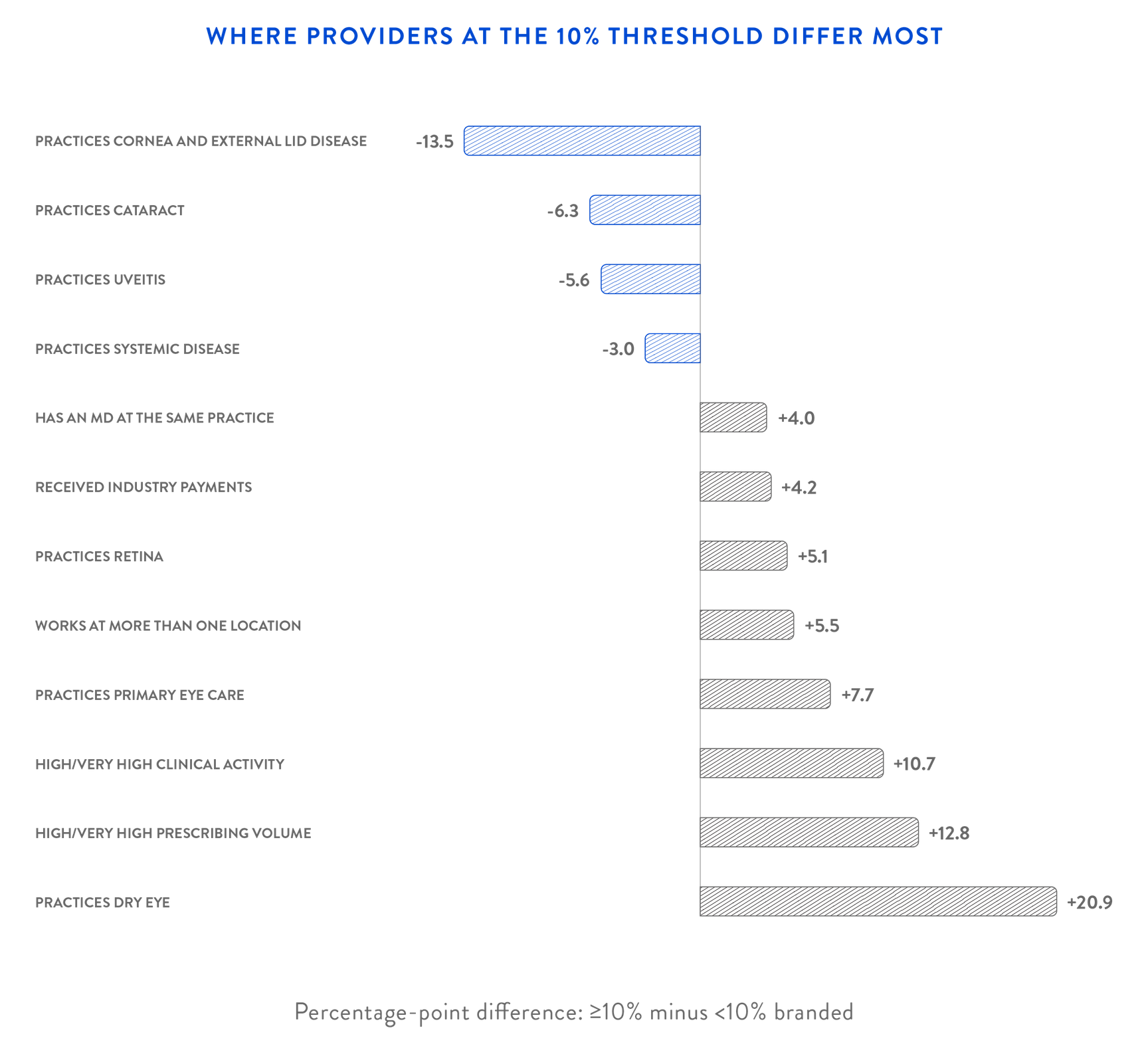
Retina also shows a positive relationship, although its 5.1 point difference remains considerably smaller.
The implication is to begin every targeting model with the product-specific clinical universe. A dry eye therapy should begin with clinicians treating meaningful dry eye populations.
The negative differences also provide important context for executives. Clinicians practicing cornea and external lid disease appear 13.5 points less frequently within the branded prescriber population under this particular definition. Cataract, uveitis, and systemic disease also show negative descriptive differences within the analyzed population.
Those differences should not become simplistic exclusion rules. Therapy availability, generic competition, treatment patterns, coding practices, and patient mix differ meaningfully across clinical categories. Instead, they reinforce why propensity models should remain therapy-specific rather than becoming universal scores across eyecare.
Branded prescribers also operate within more active clinical environments. Clinicians above the branded threshold record a median of 930 total prescriptions, compared with 577 prescriptions among clinicians below the threshold. They also record a median of 861 patients, compared with 585 patients in the comparison population.
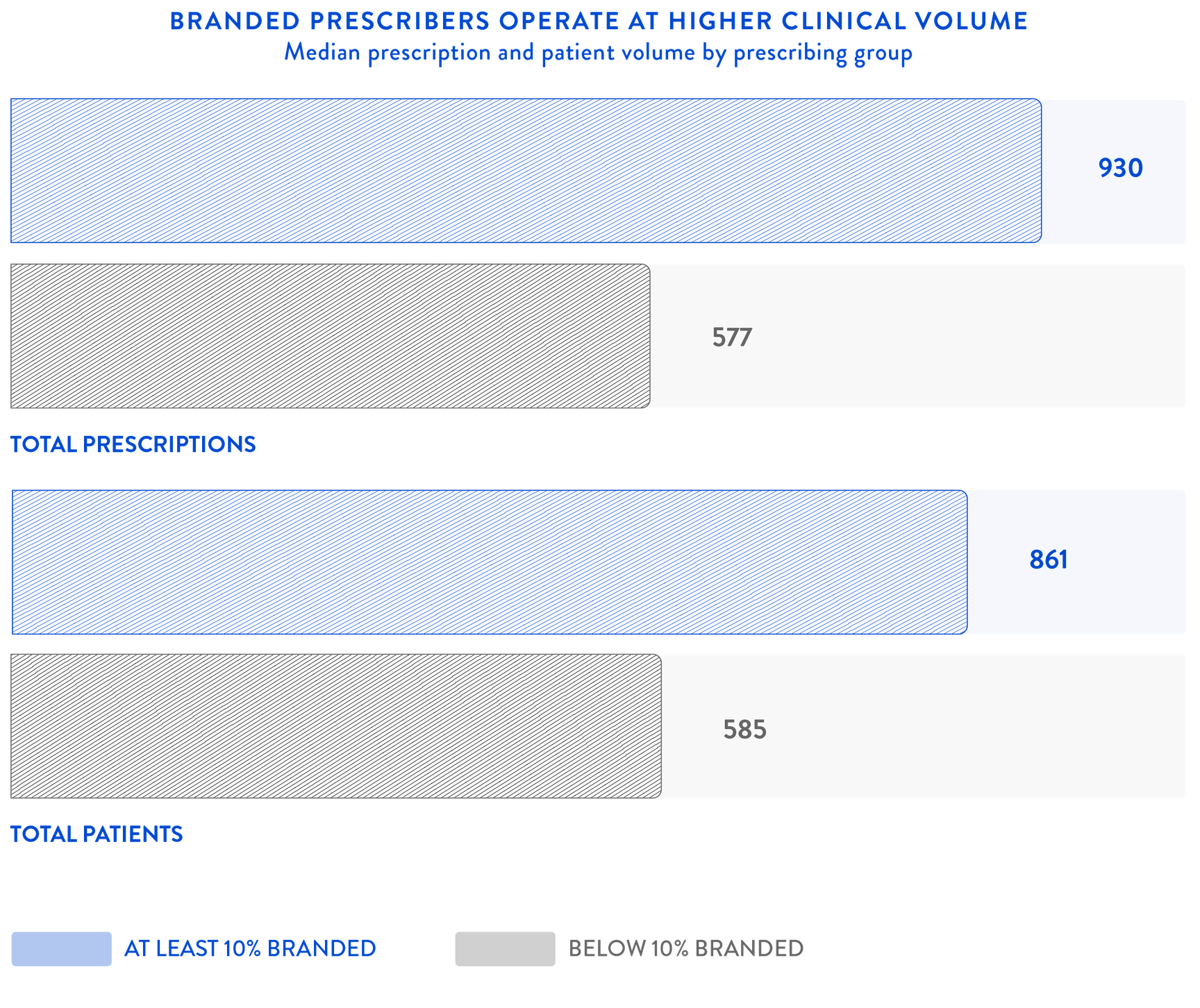
This finding does not establish that higher volume causes branded prescribing. Greater activity simply creates more treatment decisions and potentially more opportunities for appropriate branded therapies.
Professional degree provides considerably less separation between these populations. Optometrists represent 68.3 percent of clinicians above the branded threshold and 66.7 percent of clinicians below that threshold. Ophthalmologists account for 31.7 percent and 33.3 percent of the respective populations. The difference between those groups measures only 1.6 percentage points. Degree remains important for scope of practice, treatment setting, messaging, and commercial execution. However, OD versus MD segmentation alone provides very little help identifying clinicians with stronger branded prescribing behavior.
Clinicians working across more than one location appear 5.5 percentage points more frequently within the branded prescriber group. Branded prescribers are also four percentage points more likely to work within practices containing an MD. These differences suggest that practice structure provides additional context beyond specialty, prescription, and patient volume.
A high-opportunity clinician working within a larger or multi-location organization may require different engagement than a similarly active clinician operating independently. Understanding the clinician's practice can help commercial teams choose the appropriate account strategy.
Specialty, patient opportunity, prescription activity, and access conditions allow industry leaders to create multiple segments rather than one ranked target list. Immediate opportunities deserve attention, while emerging clinicians with a relevant clinical mix and growing patient count may deserve longer-term development and different engagement tactics.
The broader opportunity is to move beyond demographic targeting alone. Specialty and degree provide necessary context, although they explain only part of the commercial picture. Clinical activity, patient opportunity, prescribing behavior, and practice structure create a richer view. That richer view can change how executives allocate resources across sales, education, content, and professional engagement.