May 20, 2026
2 min read


AI is reshaping how ECPs access clinical information. Here's what the data says, and what it means for brands trying to reach them.
We recently asked 548 ECPs a pointed question: How long will it be before you rely exclusively on large language models like ChatGPT for clinical resources? Here's what they told us:
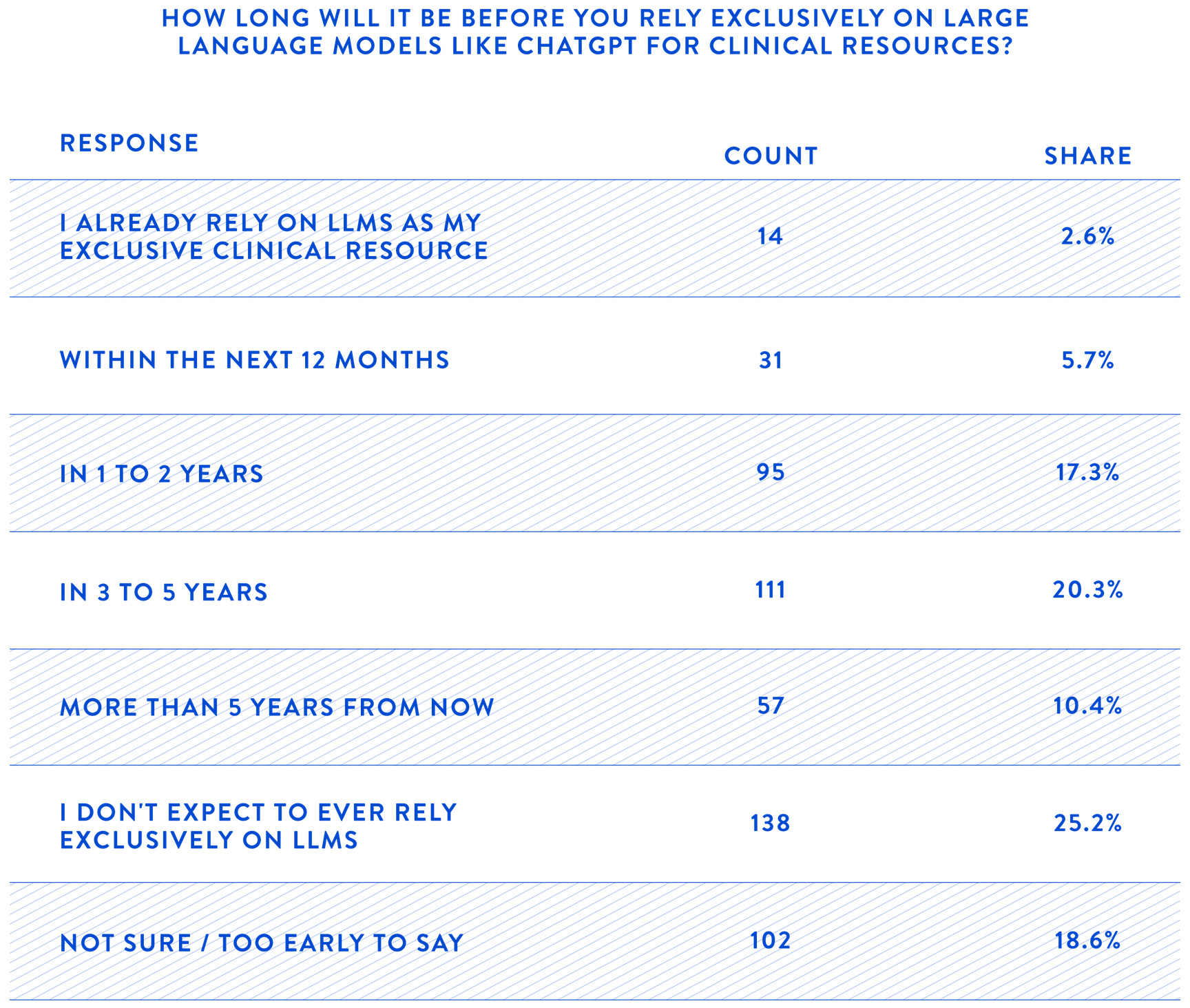
To sum it up, nearly one in four ECPs expects to rely exclusively on LLMs for clinical resources within five years. Another 18% say it's too early to tell (a number that, historically, tends to compress as technology normalizes). Meanwhile, a quarter say they'll never go all-in. This isn’t a fringe behavior anymore: more clinicians are starting to use AI tools as part of how they search, learn, and evaluate information.
Physician AI adoption at large has followed a strikingly fast trajectory. The American Medical Association found that AI use among physicians jumped from 38% in 2023 to 66% in 2024, a 78% increase in a single year.1 Among physicians already using AI, 68% said the technology offered at least some definite advantage to patient care.
Eyecare is not immune to this trend. In fact, more than 70% of optometrists believe AI will improve optometric practice.2 The doctors asking questions of LLMs today are the early adopters. This is the same cohort that tends to shape peer adoption across the rest of the profession. Early adopters in healthcare have consistently been shown to be more influential, more connected, and more likely to be the voices that bring their colleagues along. If that group is already turning to LLMs, the broader profession is watching.
The implication for brands is straightforward: the ECPs you most want to reach are disproportionately likely to already be using AI as a clinical resource. Waiting to develop a GEO strategy until adoption becomes "mainstream" means ceding influence to competitors who moved earlier.
As clinicians increasingly use AI tools to ask clinical questions, visibility inside those systems becomes increasingly important.
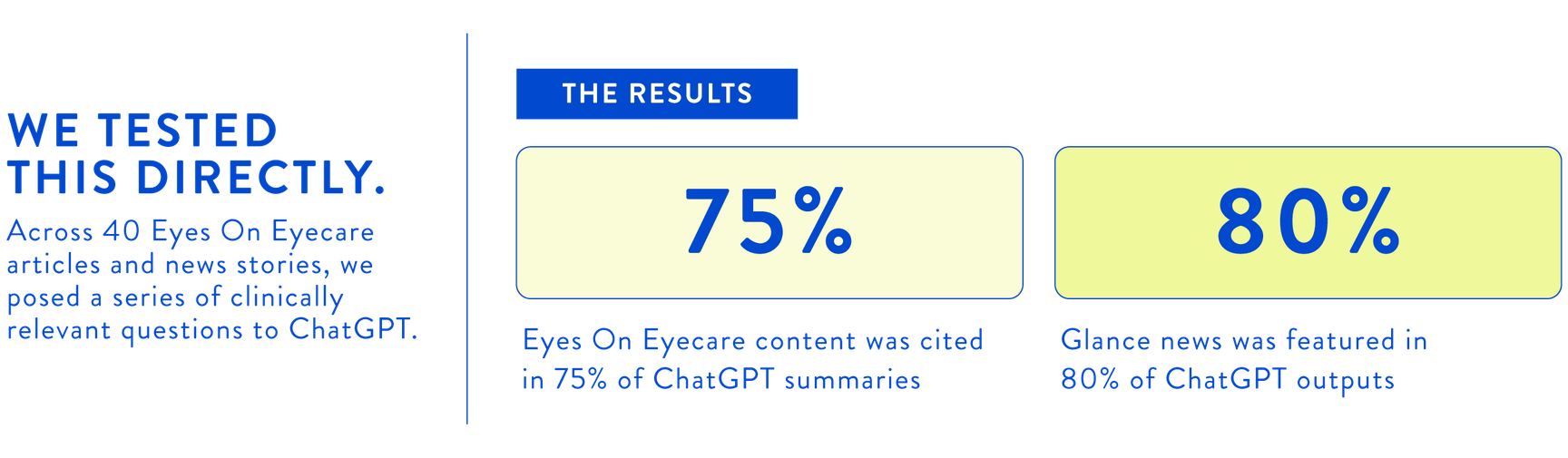
As clinicians increasingly use AI tools to ask clinical questions, visibility inside those systems becomes increasingly important. Eyes On Eyecare has already seen nearly 10% quarter-over-quarter growth in referral traffic from large language models like ChatGPT, Claude, Gemini, and Perplexity.
If AI is becoming a channel through which doctors discover and evaluate clinical tools, your content strategy needs to reflect that. Here’s what we know about how LLMs surface content:
Publish where models already trust. LLMs rely on a limited set of authoritative sources. Being featured in high-authority publications is one of the most direct ways to gain visibility.
Answer clinical questions. Content that performs well is structured around clear, specific questions and direct answers. Thought leadership that hides insights behind brand messaging gets ignored. Clear guidance like “how do I manage X in a patient with Y?” is what gets surfaced.
Include original data. LLMs favor content with proprietary statistics, clinical data, or study findings. Content with data can see 30% to 40% higher visibility in AI responses, making research and surveys especially valuable.
Be consistent and go deep. Topical authority builds over time. A single post won’t move the needle, but consistent, in-depth coverage on trusted platforms creates compounding visibility.
AI adoption among ECPs is accelerating faster than most people expected and faster than most marketing strategies have adapted. One in four ECPs expects to lean exclusively on LLMs for clinical resources within the next five years. The early adopters driving that shift are already there.
The window to establish that presence is open. But not for long.