Apr 1, 2026
2 min read


A regulatory sea change will accelerate the eyecare drug pipeline and force companies to rethink how they invest in marketing, content, and professional affairs to reach the right doctors.
On February 19, 2026, FDA Commissioner Marty Makary and CBER Director Vinay Prasad published a landmark commentary in the New England Journal of Medicine announcing that the agency’s default standard for drug approval would shift from two pivotal clinical trials to one. The change formally ends what Makary and Prasad called the “two-trial dogma,” a framework rooted in the 1960s thalidomide crisis that has governed drug approvals for over sixty years. While the FDA has technically had the authority to approve drugs on a single trial since 1997, the practical expectation of two pivotal studies persisted—until now.
The implications for optometry & ophthalmology are significant. Jefferies analyst Andrew Tsai identified ophthalmology as one of the therapeutic areas most likely to benefit from this shift. Removing a second pivotal trial could save up to $350 million per program and shave years off development timelines. Here at Eyes On, our Clinical Trials Tracker is currently tracking robust pipeline activity for 82 different trials, the most crowded being retina with 42 trials. This regulatory change could meaningfully accelerate the pace at which new therapies enter the market. The number of drugs coming to market will likely accelerate if there truly is a $350M savings per program since more investment and entrepreneurship will enter the space due to decreased financial risk.
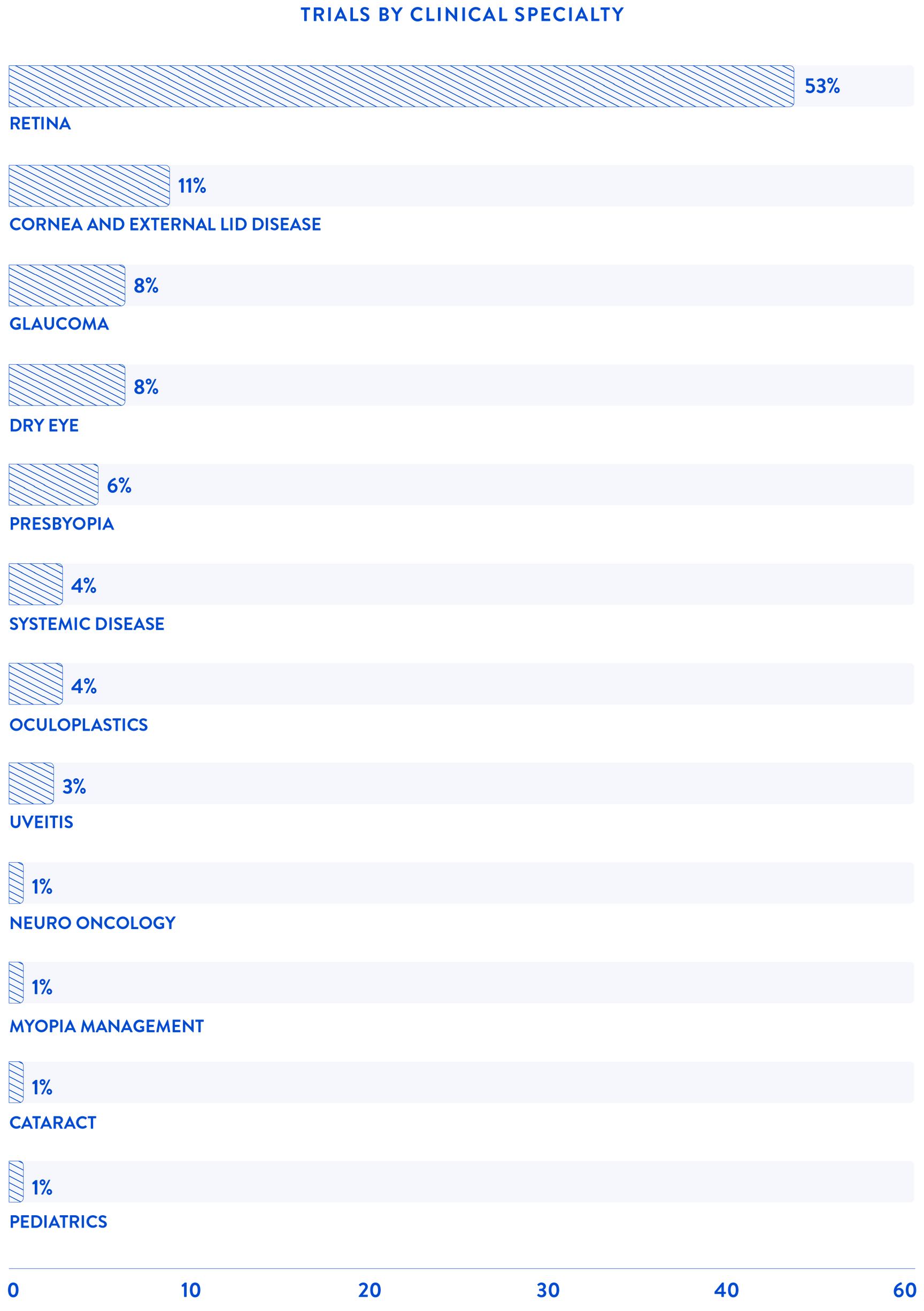
Most coverage of this policy shift has focused on the clinical and regulatory angles: faster access to therapies, potential safety trade-offs, and what it means for biotech capital allocation. But there’s a downstream consequence that very few pharmaceutical executives are discussing: a more crowded market demands a fundamentally sharper approach to reaching and changing the behavior of optometrists and ophthalmologists.
Consider the math. There are approximately 70k+ optometrists & ophthalmologists in the United States. But not all of them are relevant buyers for any given product. A new therapy for diabetic retinopathy, for example, matters to a subset of retina specialists and medically-oriented optometrists who co-manage these patients. A presbyopia drop is relevant to a different cohort entirely. If a company launches with a broad, untargeted go-to-market strategy—display ads served to the full universe of ECPs, blanket email blast campaigns, or a poorly targeted professional affairs strategy—the return on spend will be poor.
I see it all the time. Companies spend hundreds of thousands of dollars on providers who will never write their script.
When fewer drugs were entering the market each year, the cost of that inefficiency was manageable. But as the pipeline accelerates, competition for physician attention intensifies. Companies launching new therapies will need to be far more precise about whom they’re reaching, where those doctors consume clinical content, and what formats of engagement actually influence prescribing behavior.
After watching launches for the last 15 years, and experiencing many in the clinic myself, I believe there are three things that will separate the winners from the companies that waste their launch budgets:
Next-generation content formats that earn engagement, not just impressions. A standard banner ad or a single sponsored article will not break through, even if it’s NPI-targeted. The traditional content playbook—static PDFs, conventional webinars, banner ads on editorial sites—is losing its grip on physician attention. The companies that win launches will invest in content platforms and formats that blend the credibility of an academic journal with the engagement mechanics of social media: interactive clinical experiences, peer-driven video content, and case-based storytelling that lives where doctors are already spending time. The line between “medical education” and “social media” is blurring, and the brands that understand this will build the most durable share of voice.
Audience intelligence that goes beyond the static target list. Most companies today can pull a list of doctors who billed a certain CPT code, wrote a specific Rx, or treated a given ICD diagnosis. That’s table stakes. What separates the next generation of targeting is the layering of data: combining clinical claims signals with non-clinical intelligence—who’s publishing, who’s speaking at conferences, who holds leadership positions in their state association, and what their practice demographics look like. Then add a behavioral layer on top: real-time engagement signals that tell you which doctors are actively consuming content about your therapeutic area right now. That three-dimensional view—clinical, non-clinical, and behavioral—is what turns a static list into an audience strategy.
A professional affairs strategy built on precision, not proximity. Marketing gets doctors aware. Professional affairs gets them invested. Speaker bureaus, advisory boards, investigator relationships, and KOL advocacy programs are the connective tissue between a product’s clinical story and how it actually gets adopted in practice. But in a more crowded market, the margin for error in these programs shrinks. Companies can’t afford to build a speaker bureau around the same 20 names every competitor is chasing. They need to identify the next tier of influential voices—the rising star leaders, the high-volume prescribers with peer influence in their region, the physicians whose online content is shaping how colleagues think about a therapeutic category. The same audience intelligence that sharpens media targeting should inform which doctors you bring to the advisory table, who you recruit as a speaker, and where you invest in relationship-building.
The FDA’s shift to one pivotal trial is good news for patients who need faster access to new therapies. It’s good news for ophthalmic companies looking to bring innovations to market more efficiently. But it also creates a more competitive commercial landscape where the margin for marketing and professional affairs waste shrinks considerably.
Faster FDA approvals don't guarantee faster adoption. The companies that win the next decade will be the ones that know exactly which 1,000-3,000 doctors to reach and how to earn their attention.